Rune Rummy
Arrange tiles into sets and runs — Rummikub-style tile rummy
About This Game
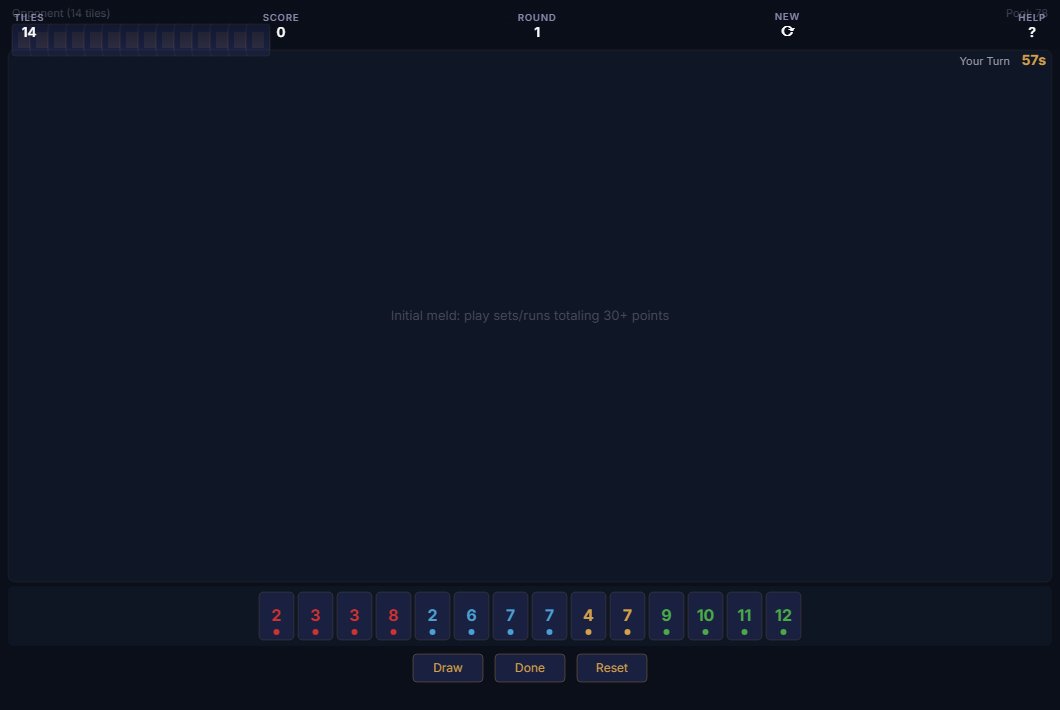
Rune Rummy is a tile-rummy game for two players — you and an AI. The goal is to be first to empty all 14 tiles from your rack onto the table. The pool has 106 tiles: two full sets of numbers 1 through 13 in four colors (red, blue, gold, and green), plus two wild jokers worth 30 points each. You build two types of melds: groups (three or four tiles with the same number but different colors) or runs (three or more consecutive numbers in the same color). Your very first meld must add up to at least 30 points. Until you hit that, all you can do is draw.
After your first meld, you can add tiles to any group or run on the table, play new melds, or rearrange existing table tiles into new combos. The one rule: everything on the table must still be valid when your turn ends. Can't play anything? Draw one tile and lose your turn. A 60-second timer keeps things moving. Jokers can fill in for any tile in any meld.
The AI also starts with 14 tiles and follows the same 30-point opening rule. Rounds go until one player empties their rack. Scores add up across rounds. The real skill is in the rearrangement — splitting a long run to free up a tile you need, or pulling tiles from different melds to form a new group.
Screenshot
History & Background
Rune Rummy is based on Rummikub, a game invented by Ephraim Hertzano in Israel in the late 1940s. He published it commercially in the early 1950s. Hertzano was an immigrant who adapted traditional rummy card-game ideas — sequences and sets — to numbered tiles. Part of the reason he used tiles was that card games were restricted in some social circles at the time. Rummikub became a big hit in Israel. It won Spiel des Jahres, Germany's top game-of-the-year award, in 1980 after being licensed to European publishers.
Tile rummy itself comes from the rummy card game family, which dates to the early 1900s and may have roots in Mahjong or the Mexican game Conquian. What Hertzano added — and what makes Rummikub different from card rummy — is the shared table and the rearrangement rule. Once a meld is on the table, any player can reorganize it on their turn. Everything just has to be valid when the turn ends. That creates a puzzle layer that card rummy doesn't have.
This version follows standard Rummikub rules: 106 tiles (two sets of 1–13 in four colors plus two jokers), 14-tile starting rack, 30-point initial meld minimum, and full table rearrangement. Jokers are worth 30 points each, which matches common tournament rules.
How to Play
- Each player starts with 14 tiles on their rack
- Play tiles to the table in valid groups (same number, different colors) or runs (consecutive, same color)
- Your first play must total at least 30 points
- On subsequent turns, you can rearrange table tiles to form new valid combinations
- All groups on the table must be valid when you end your turn
- If you can't play, draw a tile. First to empty their rack wins
Tips & Strategy
Features
Controls
Drag tiles from rack to table. Rearrange table tiles freely.
Tap and drag tiles between rack and table.