Rune Tiles
Match free pairs to clear the ancient rune board
About This Game
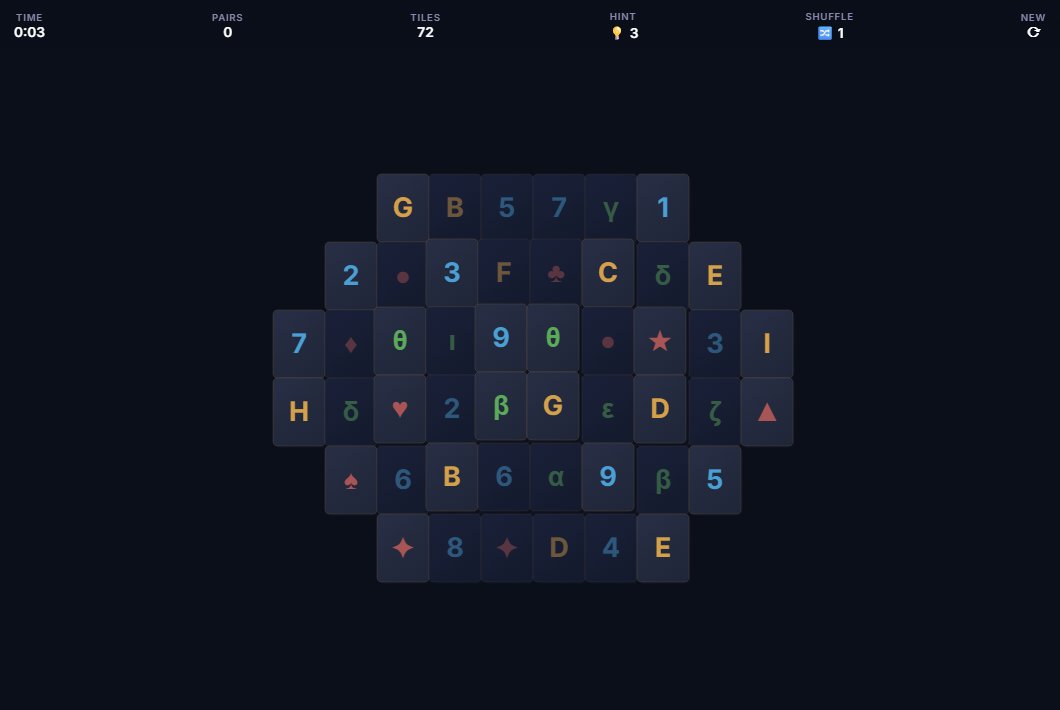
Rune Tiles is a Mahjong solitaire game played on a 72-tile board built in four stacked layers. The layout uses a turtle pattern: 48 tiles on the base, 20 on the second layer, 4 on the third, and 2 tiles at the very top. Your goal is to remove all 72 tiles by clicking matching pairs. You can only pick free tiles. A free tile has nothing stacked on top and at least one open side — left or right — not blocked by a tile in the same row.
The 72 tiles use 36 unique symbols, each appearing twice. They're split into four color-coded groups: gold letters (A through I), blue numerals (1 through 9), red shapes (stars, diamonds, triangles, and others), and green Greek letters (alpha through iota). Tiles in the same group share a color, so you can spot pairs with a quick color scan without reading every symbol. You start each game with 3 hints and 1 shuffle. Hints show you a valid pair. The shuffle rearranges all the free tiles while keeping the board structure.
Your score is based on time — the faster you clear the board, the higher you rank. The leaderboard ranks by completion time. If no valid pairs are left but tiles still remain, the game ends early. So the shuffle is a real resource, not just a panic button.
Screenshot
History & Background
Mahjong solitaire — matching tile pairs on a stacked layout — is a totally different game from the four-player Mahjong that started in 19th-century China. The solitaire form came to the West through Shanghai, a computer game released by Activision in 1986 and designed by Brodie Lockard. Lockard used the physical tiles and symbols of traditional Mahjong but invented the solitaire matching mechanic himself for solo computer play. Shanghai sold extremely well in the late 1980s and made the turtle layout the standard: a recognizable shell-and-head shape that Rune Tiles references.
Traditional Chinese Mahjong is a four-player game where you draw and discard tiles to complete sets. It's more like rummy than solitaire. The two games share a tile set but almost nothing else. The Shanghai-style solitaire spread fast through the 1990s as a bundled PC game. It showed up under dozens of names — Mahjong Trails, Mahjong Garden, and many licensed variants. All of them used Lockard's core free-tile-matching mechanic.
This version swaps the traditional Chinese tile set (bamboo, characters, circles, winds, dragons) for a custom rune alphabet in four color-coded groups. Pairs are easy to spot by both symbol and color. The three-hint, one-shuffle limit means you have to manage these tools carefully. Time-based scoring gives you a real reason to replay even after you've finished the board once.
How to Play
- Click a free tile to select it, then click its matching partner to remove the pair
- A tile is free when nothing is stacked on it and at least one side is open
- Remove all tiles from the board to win
- If no more moves are available, the game ends
- Use the hint button if you're stuck finding a valid pair
- Shuffle remaining tiles if you reach a dead end
Tips & Strategy
Features
Controls
Click tiles to select and match pairs.
Tap to select tiles and match pairs.