Block Forge
Drag blocks to fill rows and columns in this endless puzzle
About This Game
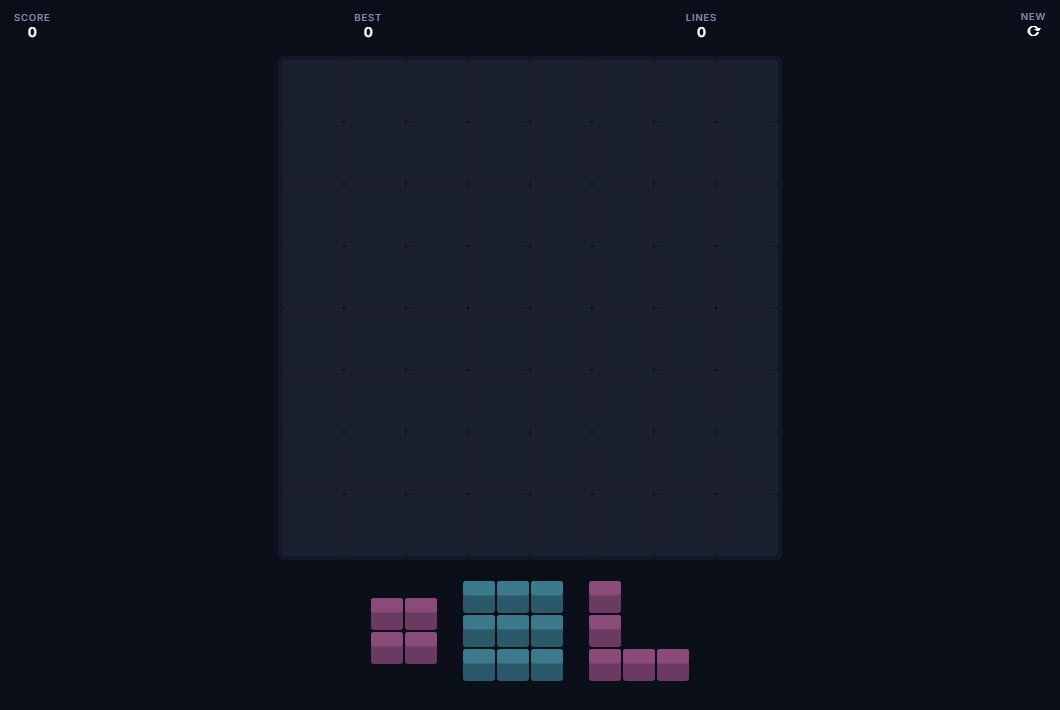
Block Forge is a puzzle game where you drag shaped blocks onto a 9×9 grid. Fill a complete row or column and it clears, earning you points. Unlike Tetris, blocks don't fall — you place them whenever you're ready. You get three blocks to place at a time. A new set of three only appears after you've placed all three current ones. The game has 22 different shapes, from a single cell up to a 3×3 square.
The real depth comes from setting up multi-line clears. Clearing two lines at once scores a 2× bonus. Three at once scores 3×, and so on. Placing one block that clears a row and a column at the same time is worth much more than dropping blocks wherever they fit. Each cell you place scores 10 points. Each line you clear scores 100 times the combo count. The game ends when none of your three available blocks can fit on the board.
Block Forge saves your high score and total lines cleared across sessions. Every run plays out differently because the shapes you get are random. The goal is always to beat your own best.
Screenshot
History & Background
Block-fitting puzzles come from polyomino math, a field that Solomon Golomb defined in a 1953 paper. He described polyominoes as shapes made of connected unit squares and studied how they could tile flat surfaces. Pentomino puzzles — arranging all 12 five-square shapes into a rectangle — became popular physical puzzles in the 1950s and 1960s.
Tetris, built by Alexey Pajitnov in 1984 and released to Western players on the Nintendo Game Boy in 1989, brought block puzzles to a huge audience. Pieces fell in real time while you arranged them — fast, stressful, and addictive. Then in the 2010s, drag-placement games like Wood Block Puzzle showed up as a calmer spin: no falling pieces, no time pressure, just fitting shapes into a grid and clearing lines. Block Forge follows that placement style. It's turn-based, not real-time. It uses 22 shape types ranging from a single cell to a 3×3 block, giving it more variety than most mobile drag-puzzle games.
How to Play
- Three block shapes are available at a time
- Drag a block from the tray onto the grid
- Complete a full row or column to clear it and score points
- Clearing multiple lines at once awards bonus points
- New blocks appear after all three current blocks are placed
- The game ends when no available block can fit on the grid
Tips & Strategy
Features
Controls
Click and drag blocks from the tray to the grid.
Tap and drag blocks to place them.