Memory Grid
Memorize symbols and find matching pairs on growing grids
About This Game
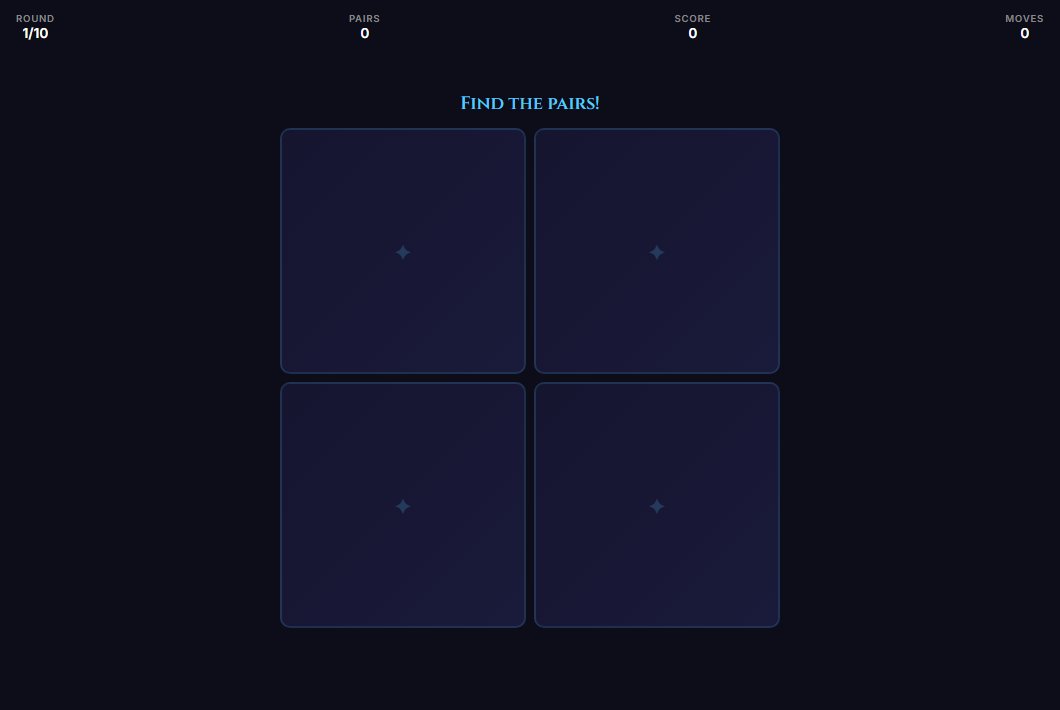
Memory Grid is a visual memory game in the IQ Forge series. Each of its 10 rounds starts with a grid of face-down cards. All the cards flip face-up for a short preview, then flip back over. You flip two cards at a time trying to find matching pairs. A match stays face-up. A miss flips both cards back down.
The grid gets bigger every round. It starts at 2x2 (two pairs) and grows through 2x3, 3x2, 2x4, 4x2, 4x3, 3x4, and two rounds of 4x4 with eight pairs each. Bigger grids get a longer preview window so you have more time to study them.
Your score rewards doing it in few moves. Each match earns 50 base points, plus a bonus for finding it quickly. Finishing a round also gives an efficiency bonus that drops with every wrong flip. The game works your working memory — your ability to hold a mental map of where things are. Working memory is one of the most studied skills in thinking research.
Screenshot
History & Background
The memory matching game — flip cards to find pairs — comes from a classic card game called Concentration. It was sold as a physical game in the United States from the 1950s. A TV game show version ran from 1958 to 1973 and made it a household name. The mental skill it uses is working memory, specifically the part that stores and updates visual and spatial information. Psychologist Alan Baddeley described this part of working memory in his influential model, first published in 1974.
Researchers later used memory matching tasks in labs to measure how well people remember spatial locations, separate from their verbal memory. Philip Corsi developed a related test in the early 1970s called the Corsi block-tapping task. It became a standard way to measure visual-spatial memory span. Grid matching games are the natural digital version of that test.
Browser memory grid games became popular in the early 2000s as simple Flash games. They remain one of the most common formats in brain-training apps. Your score does improve with practice. Research points out that the improvement mostly reflects getting better at this specific task. It's not a general boost to your overall memory.
How to Play
- Cards are briefly shown face-up, then flipped face-down
- Click two cards to flip them — if they match, they stay face-up
- If the two cards don't match, they flip back face-down
- Remember where you saw each symbol to make matches efficiently
- Clear all pairs to advance to the next (larger) round
- Complete 10 rounds with as few moves as possible
Tips & Strategy
Features
Controls
Click cards to flip them.
Tap cards to flip.