IQ Forge: Word Chain
Change one letter at a time to transform the word
About This Game
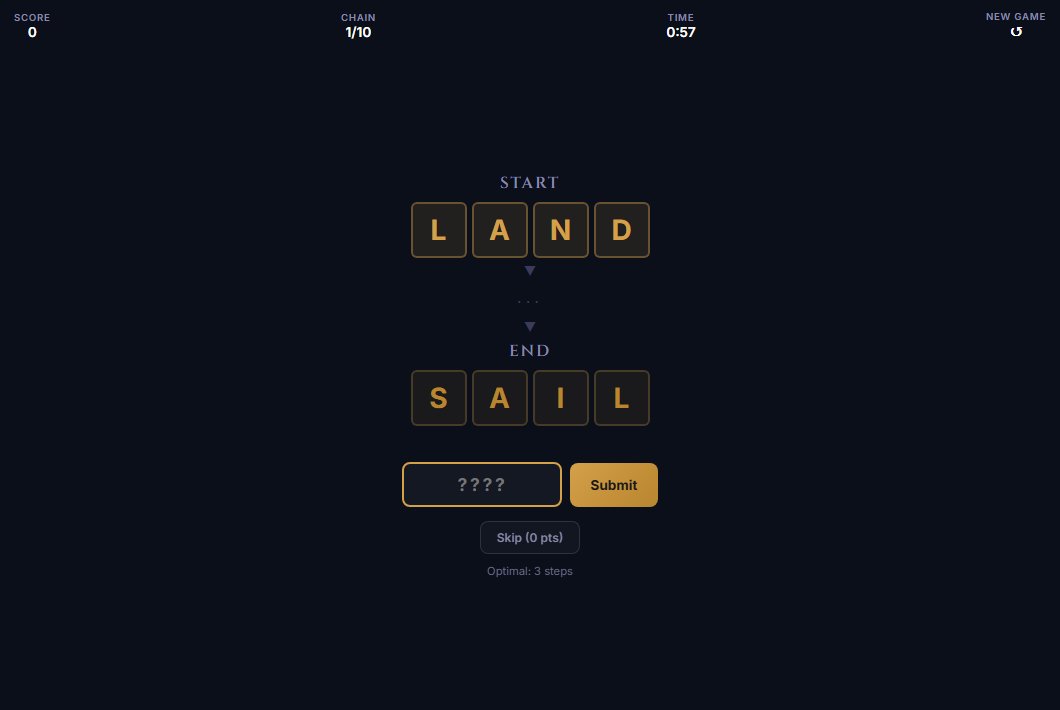
Word Chain is a word puzzle in the IQ Forge series. You start with a four-letter word and a target four-letter word. Your job is to get from one to the other by changing exactly one letter at a time. Every step must be a real English word. Classic example: COLD → CORD → WORD → WARD → WARM. Each puzzle must be solved in 60 seconds. A session covers 10 chains drawn from 36 named puzzles plus generated extras.
The game uses a pathfinding method called BFS (breadth-first search) to make sure every puzzle has a working solution. It also checks each word you enter to see if you can still reach the target from there. If you've reached a dead end, it tells you. Shorter chains score more, so finding the best path matters. The dictionary holds about 800 common four-letter words, and the game pre-maps all the connections at load time.
Word Chain tests two things at once. First, verbal fluency — how quickly you can pull words out of your memory. Second, planning — how well you plot a route through a problem before committing to it.
Screenshot
History & Background
The word ladder puzzle was invented by Lewis Carroll (the pen name of Charles Dodgson) in 1877. He published it in his "Doublets" column in Vanity Fair starting in 1879. The rules are exactly what they are today: change one letter at a time, every step a real word. His original examples include HEAD to TAIL and GRASS to GREEN. The puzzle came out as a book in 1879 and has stayed in print.
Word ladders also became a small classic in computer science classes. The problem maps cleanly onto graphs: words are nodes, one-letter differences are edges, and the best chain is the shortest path. BFS solves it neatly. Donald Knuth used word ladders as an example in The Art of Computer Programming. They show up in many intro algorithms textbooks, too.
Psychology research on verbal fluency looks at how fast and flexibly people reach words in memory. Word ladders add a planning layer on top of that. You can't just think of any word — you need a word that moves you toward the target. That makes them a test of both word speed and forward planning.
How to Play
- You're given a start word and a target word
- Change exactly one letter to form a new valid English word
- Continue changing one letter at a time until you reach the target word
- Every intermediate word must be a real English word
- Shorter chains earn more points
- Complete all rounds before time runs out
Tips & Strategy
Features
Controls
Click a letter position, type the new letter.
Tap a letter position, select from suggestions.