IQ Forge: Rotation
Which shape matches when rotated? Spatial reasoning challenge
About This Game
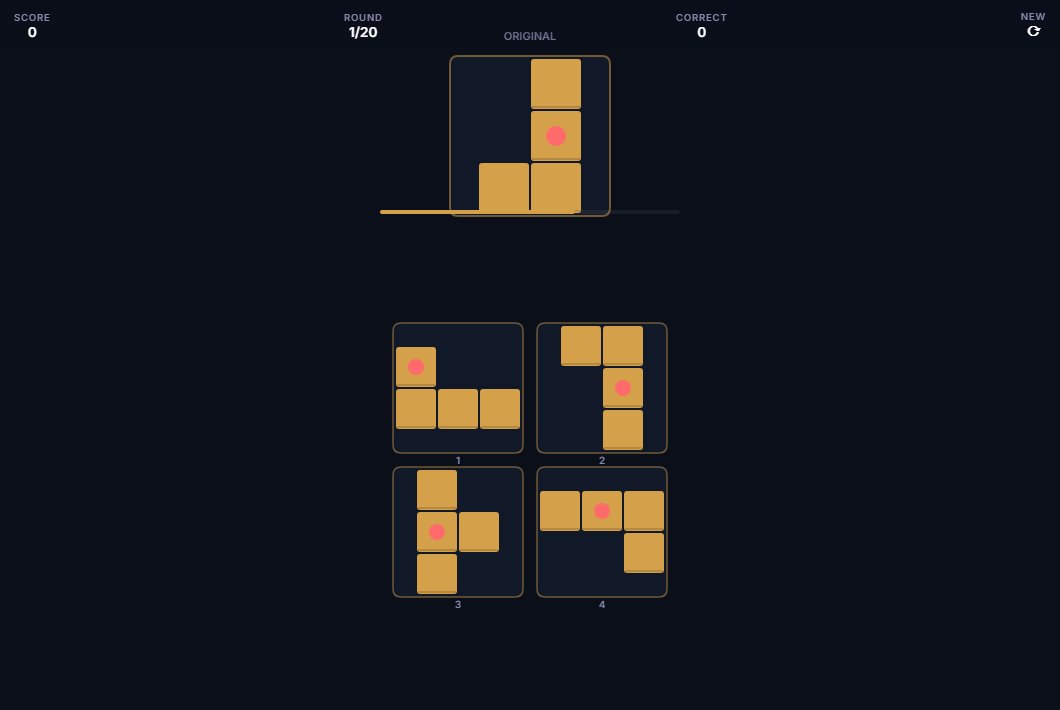
Rotation is a spatial thinking game in the IQ Forge series. Each of its 20 rounds shows a shape at the top of the screen and four options below. One option is the same shape rotated 90, 180, or 270 degrees. The other three are traps: mirror images, flipped-and-rotated versions, or shapes with one cell moved to look almost right.
Shapes are computer-generated polyominoes — grids of connected filled squares. Each shape has a marker dot on one cell. The dot is asymmetric, so you always know which way the shape is facing. Early rounds use 3- to 4-cell shapes on a 4x4 grid with 90- or 270-degree turns. Later rounds use 5- to 6-cell shapes on a 5x5 grid with all four rotation amounts in play. You get 10 seconds per round. Answer in under 3 seconds to earn a 5-point speed bonus.
Mental rotation is one of the most studied spatial skills in psychology. Researchers have linked it to ability in engineering, surgery, navigation, and math.
Screenshot
History & Background
Mental rotation as a measurable skill was established by Roger Shepard and Jacqueline Metzler in a landmark 1971 paper in Science. They showed something striking: the time needed to judge whether two 3D objects match rises steadily with the angle between them. People seem to mentally spin an image, at about 60 degrees per second for 3D shapes.
Later work by Lynn Cooper and others extended this to 2D shapes and looked at how people differ. Mental rotation shows some of the largest group differences in all of cognitive research. Practice does produce real gains. Researchers still debate why — faster mental spinning, faster strategy switching, or both.
Mental rotation tests are now standard in military selection, engineering programs, and math research. IQ Rotation uses the same core task Shepard and Metzler put on the map: find the rotated match, reject the mirrored fake.
How to Play
- A reference shape is shown at the top of the screen
- Below it, several shapes are presented as options
- Identify which option is the reference shape rotated (not mirrored or distorted)
- Click or tap your answer — faster responses earn more points
- Difficulty increases with shape complexity and number of options
- Complete 20 rounds for your final spatial reasoning score
Tips & Strategy
Features
Controls
Click the matching rotated shape.
Tap the correct option.