Odd One Out
Find the shape that breaks the pattern — 20 rounds of escalating difficulty
About This Game
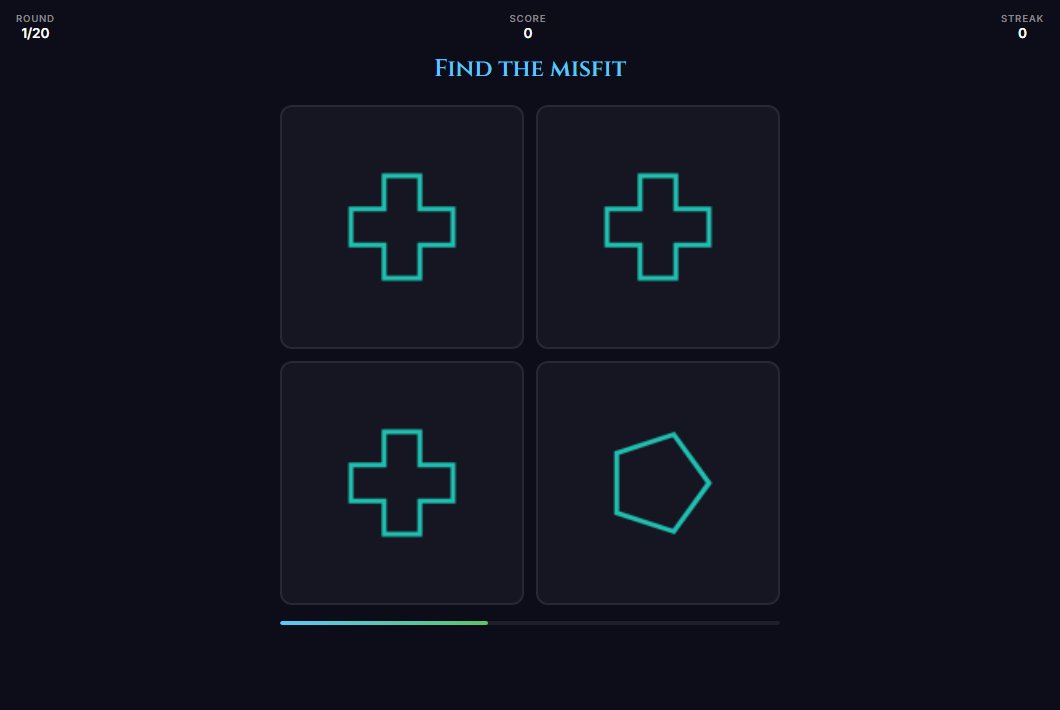
Odd One Out is a visual pattern game in the IQ Forge series. Each of its 20 rounds shows a grid of shapes. One shape doesn't belong. In early rounds the difference is easy to spot: three circles and a square, or one red shape among blue ones. As the rounds get harder, the grid grows from four shapes to nine. Differences shrink to tiny size shifts or slight rotations. The non-odd shapes also get a little jitter added, so comparing them is trickier.
Each puzzle tests one thing at a time — shape, color, size, or rotation. The game never uses circles or squares when rotation is the test. Those shapes look the same when rotated, so that would be unfair. Your score starts at 100 points per round. You also earn a time bonus from the 8-second countdown, and a streak bonus for getting answers right in a row.
This type of task has a long history in ability testing. It belongs to a group of non-verbal puzzles where you spot which item breaks the rule. Raven's Progressive Matrices, first published in 1938, used similar tasks to measure thinking ability without relying on language. Odd One Out is a direct cousin of those tests.
Screenshot
History & Background
The task of finding which item breaks a rule goes back to the early 1900s in ability testing. It's most closely tied to the work of John C. Raven. His Progressive Matrices, first published in 1938, showed that abstract pattern tasks like this could measure thinking ability without using language or school knowledge.
Visual odd-one-out tasks became common in school testing and job assessments through the mid-1900s. Researchers found that people who do well on these tasks also tend to be fast at focusing their attention and spotting patterns. Those skills help with a wide range of real-world problems.
This kind of task works well as a browser game. The puzzles can be built by a computer, the right answer is always clear-cut, and response time adds a second layer of challenge. Getting better at Odd One Out means you're getting better at fast visual comparison. Whether that carries over to other thinking skills is still an open question in research.
How to Play
- Each round presents a set of shapes — one is different from the rest
- Click or tap the shape that doesn't belong
- Answer quickly for a higher score — each round has a time limit
- Difficulty increases with each round (more shapes, subtler differences)
- Complete all 20 rounds to see your score
Tips & Strategy
Features
Controls
Click the odd shape.
Tap the odd shape.