IQ Forge: Speed Match
Does the card match the last one? Test your processing speed
About This Game
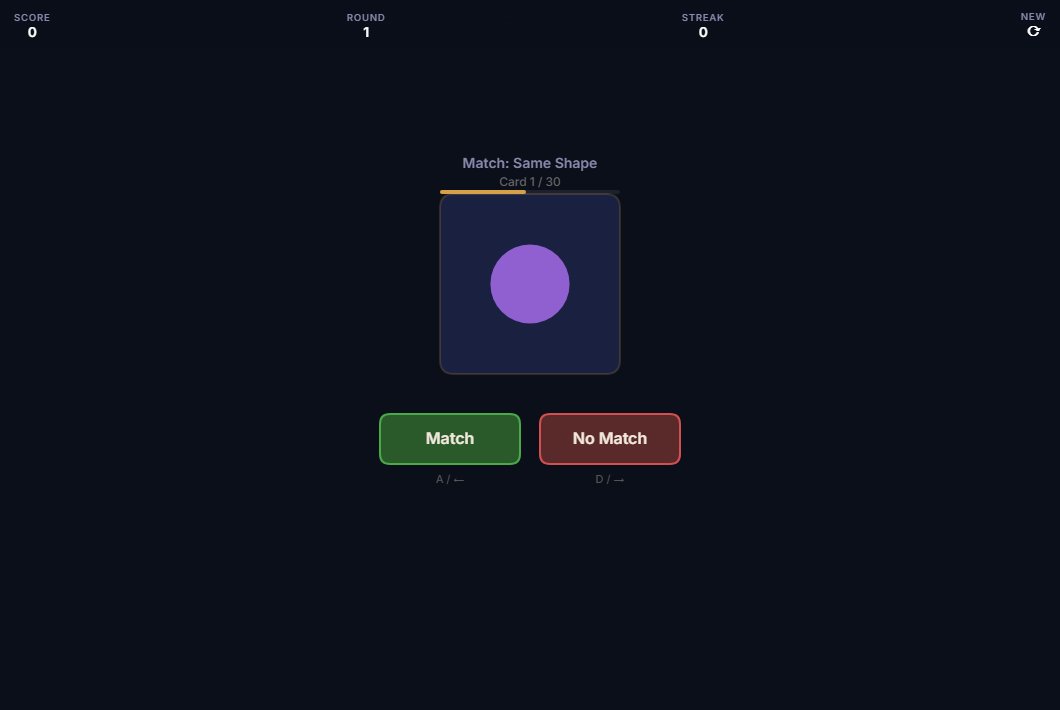
Speed Match is a fast thinking game in the IQ Forge series. Cards with colored shapes appear on screen one at a time. Starting from the second card, you decide: does this card match the one before it? The rule changes each round. Round 1 asks about shape. Round 2 asks about color. Round 3 asks if either shape or color matches. Round 4 asks if both match.
Each round has 30 scored cards plus a reference card shown first. You get 3 seconds per card. A correct answer earns 10 points. Answering in under 1 second earns a 5-point speed bonus on top. A wrong answer or timeout costs you 5 points. When the rule changes between rounds, you have to switch your thinking fast — that's the real challenge here.
The game tests two things: how quickly you can sort information (processing speed), and how well you switch between different rules (mental flexibility). Both are well-studied parts of thinking that researchers call executive function.
Screenshot
History & Background
Speed Match is based on a research task called the n-back task, first described by Wayne Kirchner in 1958. In the 1-back version — closest to this game — you compare each item to the one right before it. The task became a key tool in working memory research. In 2008, Susanne Jaeggi and her team published findings suggesting that training on a dual n-back task might improve general thinking ability. That sparked a lot of follow-up research and public interest. The big picture: evidence for broad carry-over from n-back training is still debated. What's clear is that practice makes you better at the task itself.
The rule-switching in Speed Match also connects to a research area called task-switching. In those studies, people have to apply different rules in sequence. Research shows a consistent "switch cost" — a small dip in speed or accuracy whenever the rule changes. It reflects the mental effort of updating what you're looking for.
Browser processing-speed games drew on these research traditions through the 2000s and 2010s as brain-training apps brought lab tasks to everyday players.
How to Play
- A card appears on screen. After the first card, decide: does it match the previous card?
- Press the Match button (or right arrow) if it matches the current rule
- Press the No Match button (or left arrow) if it doesn't match
- The matching rule may change between rounds (shape, color, number, or combined)
- Respond as quickly and accurately as possible
- Incorrect answers or timeouts reduce your score
Tips & Strategy
Features
Controls
Left/right arrow keys or click Match/No Match buttons.
Tap Match or No Match buttons.